For most of industrial history, a product's story ended when it left the factory. A battery, a solar inverter or an agricultural machine was judged on how well it had been engineered, and the manufacturer with the best hardware could expect to win. Today a physical product that stays disconnected from the company that made it starts losing value the moment it is sold. Nobody can see how it behaves in the field or improve it once it is installed, and sooner or later it ends up competing on price alone.
In more than forty projects across energy, industry and mobility, we have seen the same pattern repeat itself. The companies that hold on to their margins tend to be the ones that turn their products into a service that can be followed up and improved over time, which is why we sum up our view in one sentence: the physical asset opens the door, but it is the ecosystem around it that wins the market.
That idea has shaped the way we work at Biotz. We have built the whole ecosystem ourselves, on a single foundation, so that every piece shares the same data and the same logic, and so that the client can understand it and keep control of it from the very first day. Today we are presenting the three products that make it up.
- IoT Platform: The first thing a company needs is to hear from its products. Our IoT Platform connects each asset to the company that made it, collects its data continuously and works in both directions, so configurations can be adjusted, firmware updated and actions triggered across an entire fleet without anyone going into the field. That two-way connection is where the business model starts to change, because no one can sell a product as a service without knowing how it is being used.
- Event Hub: Product data is only part of the picture, though. Production records live in the ERP, customers and warranty claims in the CRM, and outside factors such as weather or energy prices shape how assets behave. That scattered information, structured and unstructured alike, is where most companies stall when they try to bring artificial intelligence into the business. The Event Hub, the newest of our products, works like a post office: every system drops its letters in one place, and the hub knows who sent each one and delivers it to whoever needs it, without the sender having to know who is listening. It is the event-driven architecture we described in our previous article, turned into a product of its own.
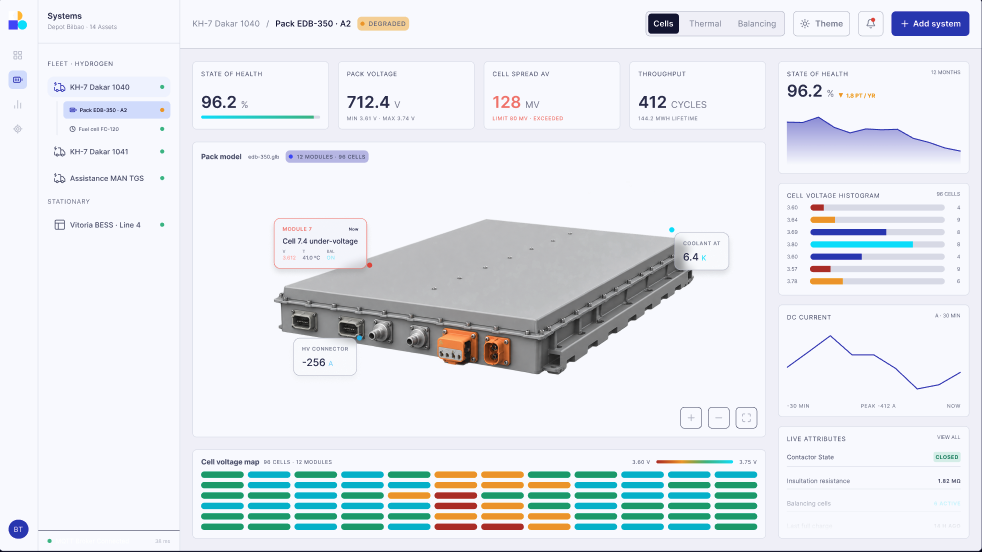
- The Semantic Digital Twin is where all of this becomes knowledge. It brings that information together in an interactive 3D model of an asset, an installation or the whole company, which can be followed in real time and also replayed or projected forward. Machine learning detects anomalies, estimates how equipment will degrade and simulates different scenarios, so decisions can be made before a failure appears. The twin also reads the manuals and procedures that usually sit in folders nobody opens, so anyone can ask a question in plain language and get an answer drawn from the company's own knowledge. Over time it becomes a knowledge graph of the business, from the purchase of materials to the delivery of the product, with the Digital Product Passport as a natural part of that record.

We designed the three products to work on their own as well as together. A company can start with the one it needs most, connect it to the systems it already has instead of replacing them, and add the rest when it makes sense, without committing to a project larger than it can absorb. Everything we build can run on the client's own infrastructure and is designed to be understood by the people who use it, so the knowledge stays inside the company and the roadmap in its hands.
Our business, in the end, is processing information, so what matters most is who controls it, and technology should extend what a company is capable of without taking control away from it. The physical asset will keep opening doors for those who build it well. What happens once the door is open depends on whether the intelligence around it still belongs to them.